


Institutionalizing a strategic partnership for education and skills development
In February 2026, in Geneva, at CERN headquarters, a Memorandum of Understanding (MOU) was signed between the Eugenides Foundation and CERN, formally establishing at the institutional level a strategic partnership that had already taken shape through many years of collaboration and coordinated efforts.
The Memorandum was signed by the Director of the Eugenides Foundation, Professor Ioannis Golias, and Dr. Ursula Bassler, Director of International Relations and Stakeholder Relations at CERN. The ceremony was attended by the President of the Eugenides Foundation, Mr. Leonidas Dimitriadis-Eugenides, the Director-General of CERN, Professor Mark Thomson, and officials from both organizations.
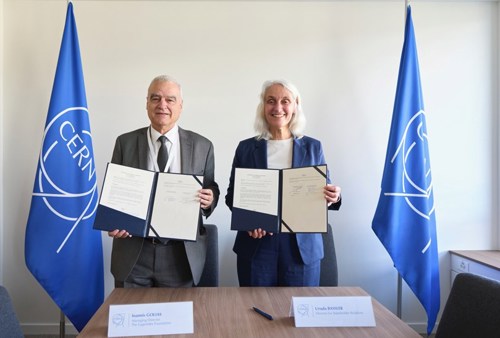
The agreement establishes a stable and structured framework for cooperation in the fields of education, with the Eugenides Foundation serving as the communication hub for CERN’s scientific activities in Greece.
“Since its founding, the Eugenides Foundation has approached science and technology not as abstract concepts, but as essential prerequisites for the advancement of applied technical professions and, through them, for improving citizens’ lives and strengthening the economy.” "In an age of information overload, the challenge is not accessing data, but understanding scientific methodology and knowledge, and translating that into practical applications," said the Foundation’s Director, Ioannis Golias.
The first pillar of this collaboration focuses on communicating cutting-edge knowledge to the Greek public, and especially to young people. The partnership highlights the journey from basic research to application. Technologies developed for the Large Hadron Collider (LHC) are now being used in biomedical research, advanced sensor systems, and touchscreen technologies for mobile devices. This multiplier effect of science highlights the connection between cutting-edge research and everyday life and is a central element of the cooperation strategy.
In this context, the following are planned:
- events, conferences, and thematic workshops,
- hosting CERN exhibitions featuring interactive exhibits and hands-on activities,
- organized student visits to the CERN facilities in Geneva,
- Development of a dedicated website and a comprehensive program to inform and engage the educational community in the Organization’s activities.
The second pillar focuses on the issue of skills and human capital. The European shortage of technical and technological skills is recognized as a critical obstacle to sustainable development. As CERN has pointed out, approximately 80% of the organization’s workforce consists of engineers and technicians, a fact that underscores its strongly technological and technical nature.
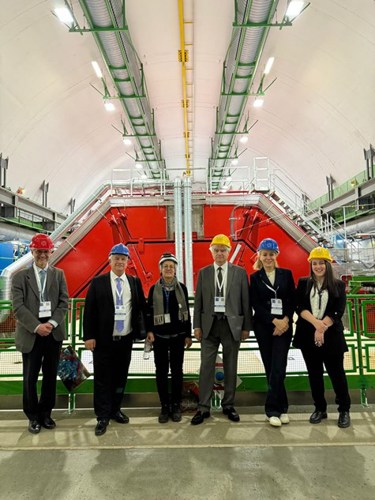
The Eugenides Foundation has extensive experience in maritime and vocational education, in the publication of educational textbooks—with more than 48 million books published over four decades—as well as in the implementation of digital transformation initiatives.
Combined with its facilities—which include one of the largest science and technology exhibitions in Europe and one of the most modern digital planetariums— attracting approximately 250,000 visitors annually, it possesses the organizational and technical foundation for the systematic transfer of knowledge to the general public and for technical education.