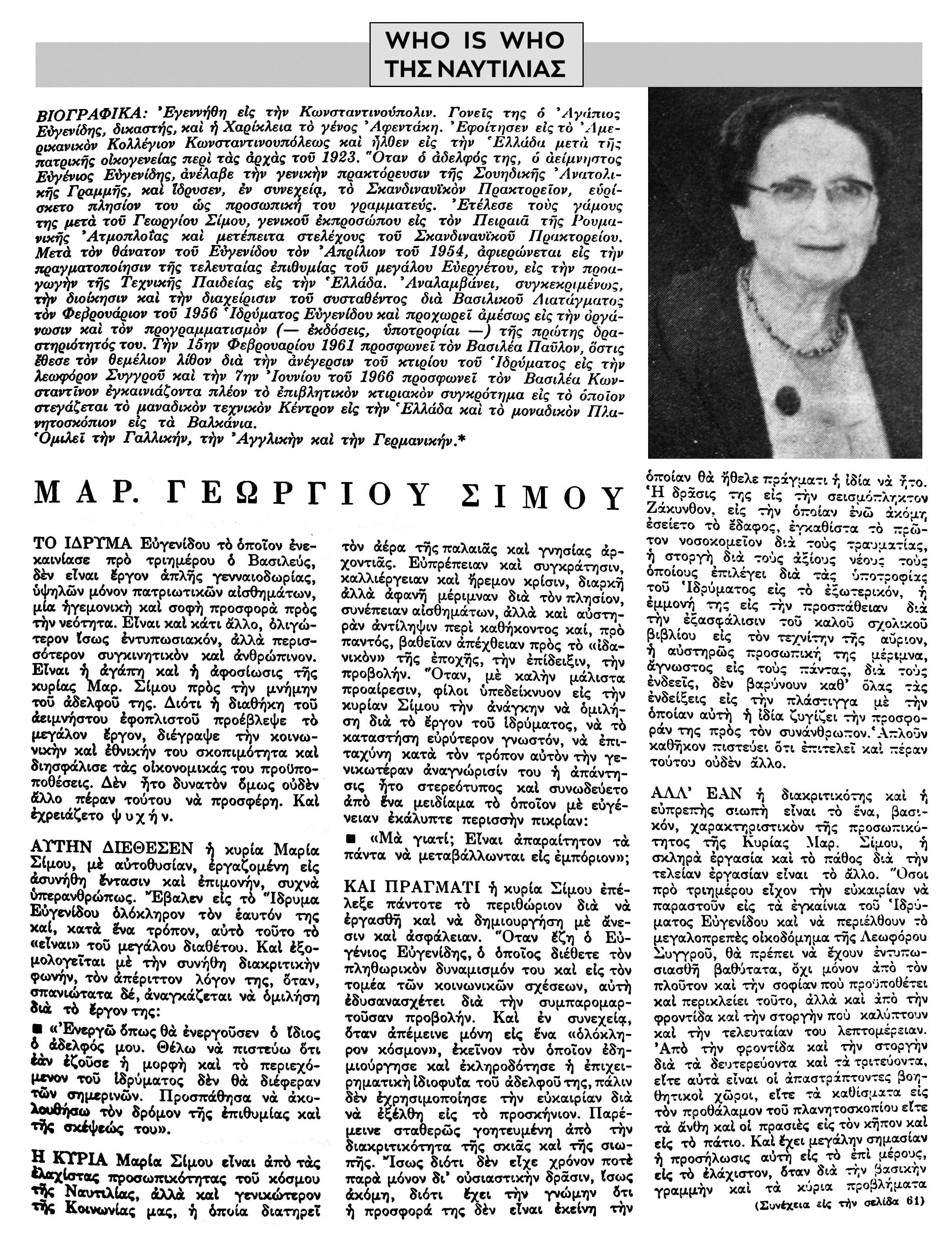
She was born in Preveza in 1895. She was the daughter of Agapios Eugenides and Charikleia Afentaki, and the sister of Eugenios Eugenides. She studied at the Zappeion Girls' School in Constantinople.
She spoke English, French, and German. Upon coming of age, she took on the role of personal secretary to her brother, Eugene Eugenides, managing the affairs of both the Scandinavian Agency and the shipping companies of the family conglomerate, primarily those based in Greece.
She married Georgios Simos, the representative in Greece for the “Romanian Steamship Company” and later a senior executive at the “Scandinavian Agency.”
In the summer of 1953, while actively participating in her brother’s efforts to aid earthquake victims on the Ionian Islands, she personally worked to set up a prefabricated hospital and a number of other medical facilities on Zakynthos.
Marianna Simou has inextricably linked her name to the realization of her brother's vision. Thanks to her, the Eugenides Foundation came into being, and thanks to the solid foundations she laid, it continues to this day, 60 years later, it continues to operate, serving the purpose set forth by the great benefactor Eugenios Eugenides, evolving, and looking to the future with optimism.
She worked hard to ensure that the Eugenides Foundation would become a pillar of technical education in Greece, a goal to which she remained deeply committed throughout her life. Moreover, she had the foresight to choose distinguished experts as her collaborators, who were just as dedicated as she was to the common cause.
She personally oversaw the design and construction of the building that would house the Foundation on Syggrou Avenue, selecting an outstanding team of engineers led by architect Andreas Kriezis.
The Foundation's first activity was awarding scholarships and writing and publishing books on technical education. Marianna Simou’s own interest in and affection for the young people who chose to study with the Foundation’s scholarships is evident from the letters she personally exchanged with the scholarship recipients, as she sought to stay informed about their progress and their needs. She was also deeply concerned with ensuring that tomorrow's craftsmen had access to good textbooks.
She had also been working since 1962 on the establishment and proper organization of the Foundation’s Library, with the aim of making it an educational, specialized library on the natural sciences and technology, which would also contribute to the fulfillment of the Foundation’s broader mission.
The organization of a permanent exhibition of technical instruments as teaching aids to facilitate the learning of technical subjects was also the work of Marianthi Simou. The preparation and organization of the exhibits that made up the Collection of Physics Experiments and Technical Exhibits (1966–1998) had begun in 1960 under her direct supervision, with the Deutsches Museum in Munich serving as the model for the exhibition.
Based on the recommendations of some of its advisors, it decided that adding a planetarium to its plans would be a real gem for the Foundation’s complex and a major attraction for students and the general public to its facilities. History has proven her right in this initiative as well, since to this day the Eugenides Foundation Planetarium remains a pioneering venue in Greece for engaging with science and technology.
Another of its initiatives was the Foundation’s contribution to the Greek government’s purchase of the sailing ship “Eugene Eugenides”—as it was honorarily named by the state—which was used for many years as a training vessel for the Merchant Marine Academies.
This was a contribution to the country’s maritime education, in the area of practical training for the future officers of the Merchant Marine, which complemented the Foundation’s contribution to the theoretical aspects of their studies, through the writing and publication of appropriate textbooks.
Although she always worked quietly, without seeking personal recognition or social acclaim, the Greek government and various scientific and cultural institutions recognized her work, awarding her a number of honors: the Gold Medal of the Academy of Athens, the Medal and Diploma of the Municipality of Athens, the Award of the Municipalities and Communities of Greece, the Grand Commander of the Order of Philanthropy, the Grand Commander of the Order of Honor, as well as the First-Class Naval Medal.
Marianna Simou died on April 17, 1981, leaving behind a remarkable body of work that, fortunately, found worthy successors. She herself was a unique example of a person devoted to what she considered her duty, making the sacred mission of the Eugenides Foundation her life’s purpose, as envisioned by her late brother.
Marianthi Simou, as featured in theWHO'S WHO OF SHIPPING section of the ARGO newspaper, 1966